 |
| About The Work + Interview France Culture + Texts + |
    |
| Bio / Contact |
| ------------------ |
| Time loops |
| (selected works) |
| 2026 |
| 2026 Studies |
| 2020-2025 |
| ------------------ |
 On The Side On The Side |
| (selected works) |
|
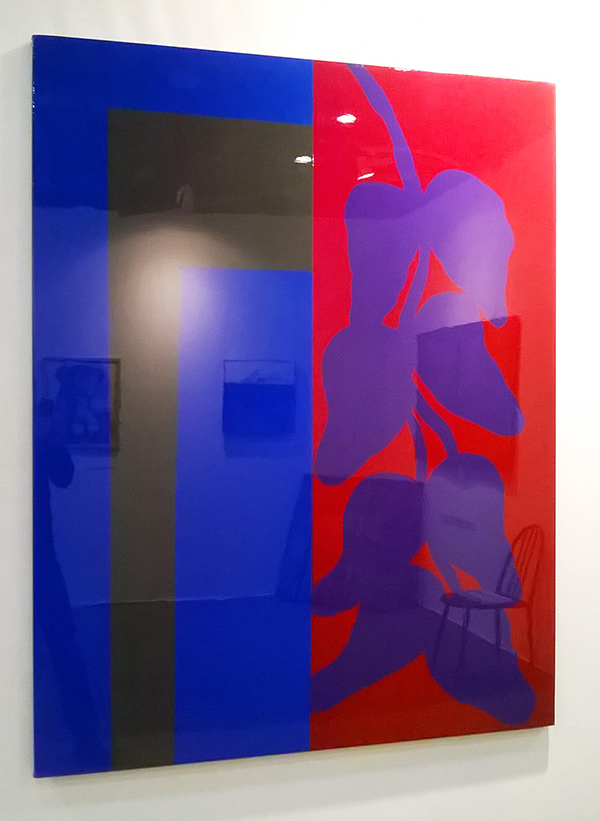
Reverse Paintings : a conceptual work "I paint on the back of a flexible, transparent vinyl film that is then stretched on a frame. I erase any tactile trace of my work, there is no material, just a mirror surface. I give the painting an ambiguous identity by making it function as a facsimile. What interests me is the production system of a painting, its mode of perception as an object without being reduced to a process. It can vary infinitely through different series and open up to multiple possibilities." Jean-Daniel Salvat, New York, 1995 |
|
|
Maison de la Radio, Paris – broadcast July 8, 2008
|
||
| Elisabeth Couturier directs the collection Le Guide at Flammarion, where she authored the bestseller Contemporary Art. She has produced several programs for Radio France Culture, contributed to Paris Match for more than fifteen years, as well as to the prestigious magazine L’Œil, and authored the series The Little Secrets of Great Paintings broadcast on ARTE. She is also Secretary General of the International Association of Art Critics and an exhibition curator. |

Critical Texts
From Support to Surface
A former student of Claude Viallat, should we be surprised that Jean-Daniel Salvat raises questions once central to the Supports/Surfaces movement? Yet he provides answers that are uniquely his own.
He still occasionally runs into his former and illustrious professor from the École des Beaux-Arts in the streets of Nîmes. “Claude Viallat lives not far from me. He is someone who mattered to me. With such a career!” Jean-Daniel Salvat remarks. He was Viallat’s student in the early 1990s before moving to Paris and then to New York, where he lived from 1995 to 2005.
Having been trained by one of the leading figures of Supports/Surfaces does not necessarily imply an approach to painting rooted in the concerns of what is considered the last French avant-garde movement of the 20th century. “It is difficult to escape, here more than elsewhere, questions about painting, the work, the subject, materials…” Salvat nevertheless acknowledges with an implicit broad smile.
Standing before his large, smooth and glossy formats made on transparent vinyl, one might imagine him far removed from the original issues of Supports/Surfaces. And yet, if he now opts for a flexible plastic film rather than rigid Plexiglas, it is precisely so he can adapt it to that famous stretcher which so preoccupied his illustrious predecessors—we know Viallat’s formula recounting the adventure of Supports/Surfaces: “Dezeuze painted without canvas, I painted canvases without stretchers, and Saytour painted the image of the stretcher on the canvas.”
The enjoyment of a painting freed from any mimetic or symbolic intention, embracing only the language of color and two-dimensional forms, underlies Jean-Daniel Salvat’s artistic approach, as evidenced in his Monoblocs series. These works, composed of two equal parts, stage—on a carefully rendered flat field of color—a more rudimentary and vaguely identifiable graphic motif: grid, flower, rhizome, object…
Painted on the reverse of the support, in the manner of reverse glass painting, each Monobloc thus operates on a tension between an impression of industrial reality—smooth, clean, flashy—and a rudimentary drawing (paint runs over, lines are approximate, the imprint of the “brush,” or whatever substitutes for it, does not hide…) that betrays the painter’s handcrafted gesture. Salvat’s work multiplies points of entry and levels of reading, as the unlikely heir to a pop-inflected minimalism with a post-Support-Surface tendency.
If we may also be on the threshold of an aesthetic of seduction, of a radicalism that knows how to please, the proposition remains coherent, grounded in this ambiguity between trace and immateriality, between the reality of painting and its distancing, introduced by this effect of transparency which Salvat recalls was constantly sought by Bacon, “whose paintings are always covered with glass.”
Thus Jean-Daniel Salvat moves “from support to surface,” in work that demonstrates the artist’s ability to reformulate new propositions while remaining faithful to a precise line of conduct. In echo, Viallat’s advice: “to say the same thing without ever repeating oneself.”
Serge Hartmann
The Reverse Side of Antimatter
Jean-Daniel Salvat reconciles practices and techniques reputed to be irreconcilable, reduces irreparably raw aesthetic fractures, and marries approaches and movements labeled radically antinomic. This resolution of multiple squarings of the circle occurred naturally—the culmination of a reasoned research process, of a goal to be achieved, and of a rigorous inquiry into painting as matter: its supports, the treatment of color, its relation to volume, the space allotted to pictorial language, notions of perspective and depth, and the viewer’s relationship to the work as object.
Salvat might incidentally respond to Ben Vautier’s aphoristic question: “If the new is no longer new, is not making something new new?” But that is not his point, even if he adds grist to the mill of the Nice-born pope of free figuration by playing simultaneously on the two fronts of invention and tradition. If he succeeds, it is by resolving the problem of painting in its consistency and thickness—obstacles to the concept of the smooth image sublimated in magazines. If the gaze cannot stop at the material, which cannot in itself produce meaning in representation, the sign matters because it takes on consistency through a defined process and substance. Salvat discards anecdote to focus on fact.
Curiously, he achieves this by reconnecting with the technique of reverse glass painting via a vinyl film stretched over a frame. The transparency of the support allows him to paint on the reverse, and the texture of the medium produces that almost banal and wholly artificial effect experienced in the presence of a simple reproduction. While glass preserves the purely graphic expression of reverse painting—its tactile dimension and undeniable density—by giving the illusion of merely protecting a very classical work on paper; conversely, vinyl seems to absorb the hue into the thickness of the film, conferring upon it the absolutely flat appearance of a surface polished to brilliance, to the point of confusion with a digital image. This confusion is further heightened by the use of crude industrial alkyd colors.
Salvat, however, returns to painting by introducing, in his own words, “tempered clumsiness.” By not attempting to conceal imperfections and shortcomings, he seeks to bear witness to the artist’s labor, leaving a trace of the absolute primacy of gesture. Painting is also present in recurring references to movements that marked contemporary art history, notably Supports/Surfaces, Pop Art, Pattern Painting, and Abstract Expressionism in the use of dripping. Thus anti-materialist yet truly graphic and authentically colorist, Salvat restores painting to the pure beauty of its function through the evidence of representation.
Roland Duclos
Skin of the Skin: The Thingness of Painting
It is always thus with painting and the so-called figurative arts: glimpsing, seeing, believing one sees, believing when there is no longer painting but merely an image—when after Bonnard it is “white Bonnard and Bonnard white” (Beckett). Thus everything must always be taken up again, begun anew, to reach that impalpable element: the thingness of painting that enters the eyes, the mind suddenly affected by something that is not dead skin.
To achieve this, Salvat’s ambition is both simple and complex: “I want to make a painting as manufactured as possible, without emotive transcription, in a spirit of emptiness. The serial aspect of my work, its cool elegance, anonymous motifs, industrial colors—all contribute to this identity.” Such elements participate in what escapes, in that paradoxical handicap that proposes a painting which, in its preciousness, cannot be called naive or mute, yet allows us to recognize the least recognizable.
Born in Aurillac in 1969, Salvat worked in Paris and then New York. His major approach is painting under vinyl. The artist defines it thus: “I paint on the reverse of a flexible transparent vinyl. I erase all tactile trace of my work; there is no material, just a smooth and glossy surface. I give the painting an ambiguous identity by making it function as its own facsimile.”
As a result, certain ineffable forms of emptiness, altitude, suspension, here and elsewhere emerge. It is pensive but not self-contained: in matter, or rather on the smooth skin that creates a new relationship awaiting intrigue or recuperation, placing the very surface of painting into abyss. From this postulate Salvat can specify: “What interests me is the production system of a painting, its mode of perception as an object, without it being reduced to a process—so that it can vary infinitely and open up multiple potentialities.”
Journey against journey, potentialities or hypotheses against virtualities: such is the story not of painting but of a body of work that shifts forms and lines, as well as the question of surface, which through synthesis of positioning or “fabrication” becomes a changing texture. Without refusing (and one may salute him for this) painting-as-painting, the artist extrapolates it both in its conception and its reception. Three surfaces compete, create tensions within an “image” that also plays with colors. These accentuate rhythms and differences in a relationship that remains problematic in the viewer’s eyes.
That is the full interest of this approach which, rather than opening windows, releases them into the void to see what happens in this aerial glide where the eye faces—supreme paradox—a flat abyss in which the spectacle of the world is suspended, counteracted. Before such visual language in combat, the viewer has the final word over the painter. Thus the trapper is trapped: the image that sought not to captivate is captured. But that is where the essential occurs: something advances, since visual finality is no longer reduced to stiffness.
There is never progress in art: the image appears, almost immediately disappears, covered over; scarcely has its reign arrived than it collapses. Salvat knows this, which is why he endlessly repeats his leap into the void to push back margins and frames—so that appearance does not close in the moment of birth.
This is the thingness of art that the creator delivers to free us from our ways of seeing. What is art, if not what such a painter makes of it: a simple story spread out, but in a dual manner? What do we see, indeed, if not colored forms: phantoms, flows, illuminations, grimaces of diverted nature so that on the “skin” something stands off-balance? Through surface effect, what shows above somehow “bursts” below. Gently, on the ground, Salvat reveals the wound of the naked and groundless thing that art had repressed until now.
The artist makes his work by becoming an object without object, for it always remains to be born. It is the echo of what was awaited yet not what was expected in such forms. Such work thus places art in peril through an unprecedented relationship between the finished and the unfinished. Suddenly the viewer undergoes this unique experience: forgetting his gaze, forgetting images through those that suddenly overflow him.
If at first he sees nothing in this mystery—which is first pleasure before being a problem—that is not important. It is even the guarantee of truth in a work that devours the gaze, transforming it into a cry. One might call this pushing back appearances where, though there is only surface effect, nothing but a “skin” forgotten upon the skin of the secret torn from silence to relearn the meaning of what we are.
Jean-Paul Gavard-Perret
Reflections of Living Abstraction
The surfaces are smooth and the colors radiant. The works of painter Jean-Daniel Salvat possess the ambiguity of reflection where every trace of pictorial gesture seems to have disappeared; they vibrate like emanations of light. Yet one senses a deliberate choice, a deep knowledge of the play of colors and an intuitive sense of form. Imprints respond to one another in juxtaposed square spaces, impressions seemingly born of sustained pictorial research.
The artist says he wishes to paint in a spirit of emptiness, yet the arabesques on monochrome grounds evoke more the puzzle of life than the relative indifference of an intellectual approach. Jean-Daniel Salvat, who paints on the reverse of flexible transparent vinyl, clearly defines his aesthetic research. But often highly conscious theory and thoughtful concept do not prevent the pleasure of color and form from expressing themselves all the more freely.
When the painter tells us, “I give the painting an ambiguous identity by making it function as its own facsimile,” he adds a dimension to his carefully conceived works whose syntax offers every possibility for the play of hues and astonishing, pleasurable formal diversity. Colors meet happily: brown with orange arabesques stands out from gray crossed by an emerald flocculent surge; dark red is speckled with pink dots. Each panel proposes a new selection of striking and playful contrasts. Jean-Daniel Salvat questions the genesis of the work and its perception.
A genuine style has emerged from his questioning of aesthetic codes. The serial aspect of the structures may give the false impression of mechanical intervention in production, whereas it is manually executed painting. Certain strokes of vigorous beauty could not deceive. The choice of tonalities remains restricted for each painting, yet the selection is highly successful.
The artist shows us a parallel world, one where painting exists by itself as an independent object and unavoidable presence that delights us. There are currently many works situated between painting and object that question the relationship between art and reality. Jean-Daniel Salvat clearly defines the subject of his research: “What interests me is the production system of a painting, its mode of perception as an object.”
Looking at the stages of this French creator’s career, one is not surprised by the influence that the American painting spirit—with its incessant need to experiment—had on his art: from 1995 to 2005 the painter lived in New York. Each painting has a specific character. Even if every trace of personal “handwriting” is erased, each work reflects an identity whose structural rigor is lightened by subtle ruptures within geometric composition.
Those attached to research in art will receive this painting as a gift, in the spirit defined by Jean-Daniel Salvat: “I erase all tactile trace of my work; there is no material, just a smooth and glossy surface.”
Hilda Van Heel
Painting in a Critical State
Jean-Daniel Salvat’s work develops at a particular moment in the history of art: that of the “after.” After the avant-gardes, after heroic abstraction, after the radical deconstructions of painting. In this context, saturated with references and doubts, Salvat seeks neither spectacular rupture nor nostalgic return. He chooses a more demanding path: to work on painting from within its very conditions of existence.
His work clearly belongs to the legacy of the questions raised by Supports/Surfaces, yet without adopting its programmatic discourse. Where that movement exposed painting to its own elements - canvas, stretcher, color, gesture - Salvat takes this as a historical given. He no longer analyzes painting; he works within its critical state. The painting is no longer dismantled; it is reconfigured.
The choice of transparent vinyl painted on the reverse side is fundamental in this respect. It introduces a radical distance between the gesture and what is perceived. Paint no longer presents itself as deposited matter, but as a closed, smooth, almost mute surface. The viewer can no longer cling to expressive traces; instead, they are compelled to enter into an optical, mental, almost speculative relationship with the work. This shift profoundly transforms the position of the spectator, who becomes active, attentive, engaged in a slow reading.
Formally, Salvat’s compositions may at first appear rigorous, sometimes almost austere. But this rigor is deceptive. The forms, often geometric, do not belong to a stable system. They float, brush against one another, find balance without ever becoming fixed. There is neither center nor obvious hierarchy. The painting operates as a field of forces, a relational space in which each element depends on the others without ever fully resolving into them.
This controlled instability gives the work a paradoxical dimension: it is at once constructed and fragile, determined and open. This is perhaps where the depth of Salvat’s work lies. Painting is no longer a site of formal resolution, but a space of visual thought. It does not offer an image to be consumed, but a situation to be experienced.
In the contemporary landscape, often dominated by narrative, spectacular imagery, or the hybridization of media, Salvat’s position is singular. He fully embraces painting as an autonomous medium while refusing its mythologies. He paints neither the world, nor himself, nor a story: he paints the conditions of possibility of a painting today.
His work thus addresses a viewer who is available, ready to accept a form of silence. It does not seek immediate adherence, but duration. It reveals itself over time, through repeated looking, through a gradual awareness of its internal balances. In this way, Jean-Daniel Salvat’s work affirms an ethics of painting: a demanding, discreet, yet profoundly contemporary practice that turns the painting from an answer into a question held open.
Meta
